Time-Based Digital Art Museum
The Temporal Gallery
Making digital art feel precious
In 2025, I was taking an online course called In the Studio: Postwar Abstract Painting. One lecture stopped me — it talked about how the physical act of standing in front of a painting, at a specific time, in a specific light, changes how you experience it. You can't replicate that online. Everything is always available, all at once.
That idea stuck with me. What if a digital gallery worked like a real museum — where certain works only appear at dawn, others at noon, some only at midnight? What if the time you visited changed what you could see?
The concept: create scarcity in abundance. Make digital art feel as precious as walking into a museum that's only open for specific hours. Force people to slow down, to appreciate what's available right now, and to come back at different times to see more. This isn't just an art gallery. It's about adding the one thing the internet can't usually offer: time constraints.
Mapping out the solution
I started by researching existing digital art platforms — Google Arts & Culture, Artsy, SuperRare. They all had one thing in common: everything was always available. I wanted to flip that.
The time-based logic: Dawn (5am–11am) for soft, morning-light pieces; Noon (11am–5pm) for bright, energetic works; Dusk (5pm–11pm) for warm, reflective art; Midnight (11pm–5am) for dark, mysterious pieces. I sketched different UI approaches — grids, carousels, immersive full-screen — and settled on a dark, cinematic aesthetic with glitch effects to create that "museum after hours" vibe.
Technical challenges: how do I track time reliably across time zones? What happens if someone changes their device time? How do I make transitions feel magical, not abrupt? I built the first prototype in vanilla JavaScript to test the time logic. Once confirmed, I focused on the aesthetic — dark backgrounds, smooth fades, subtle animations. The hardest part wasn't the code. It was curating the art and deciding which pieces belonged to which time period.
The Product
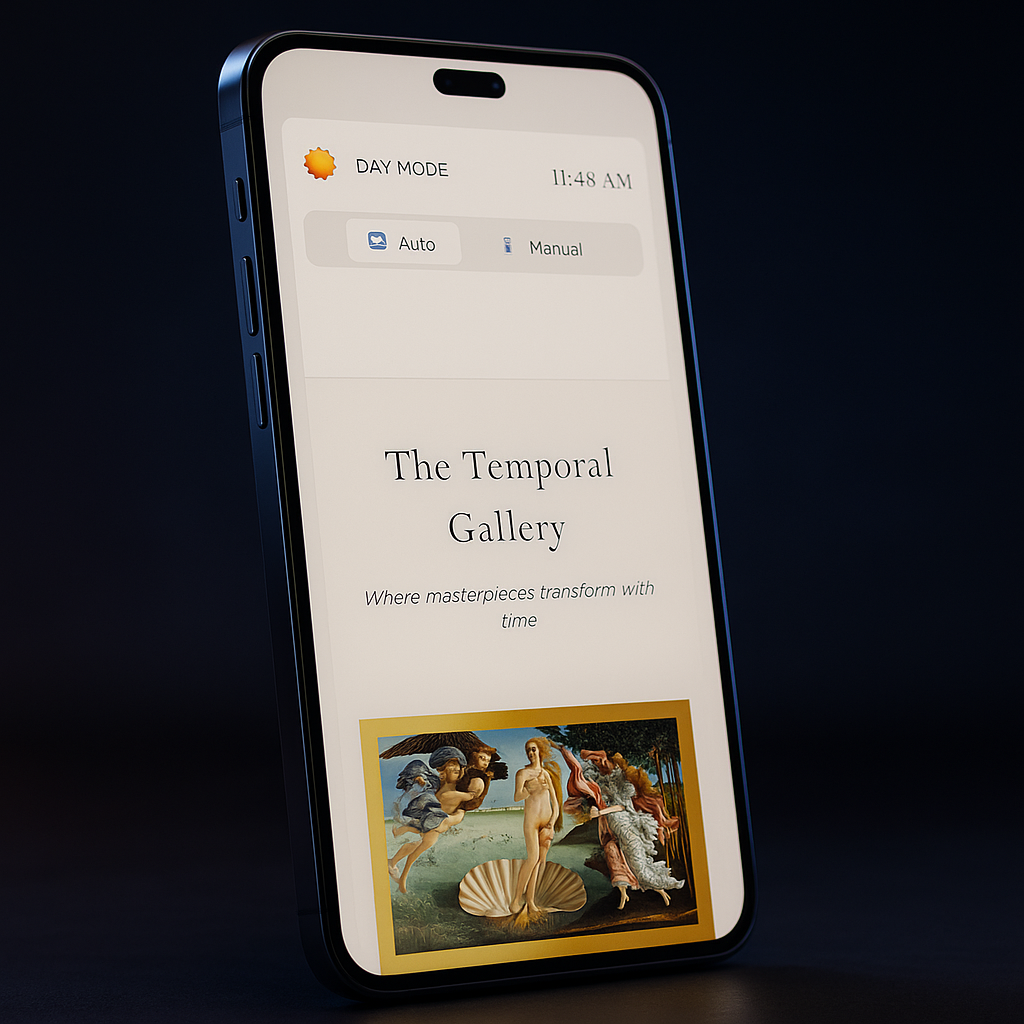
The final result is a living, breathing art museum that exists in time. When you visit The Temporal Gallery, you only see artworks meant for the current hour. A piece available at dawn is completely invisible at midnight.
This creates urgency ("I need to see this before it disappears"), exclusivity ("not everyone can see what I'm seeing right now"), and repeat visits ("I'll come back tonight for the midnight collection"). Features include time-sensitive artwork visibility, smooth fade animations, interactive artwork cards with artist info, dark cinematic UI with glitch effects, and a real-time clock showing the current period.
The experience mimics walking into a museum at different times of day. The art changes. The mood changes. You change.
Final Product
Tech Stack
What I Learned
Key Takeaways
Constraints create value
Making art temporarily unavailable made people appreciate it more. Scarcity works — even (especially) in digital spaces.
Time is an underused design element
Most apps ignore time or use it passively. Making time an active player in the experience opened entirely new possibilities.
Curation is harder than code
The technical implementation took 2 days. Curating which art belonged to which time period took 2 weeks. Design decisions matter more than technical complexity.
Aesthetic matters for art
The dark, glitchy museum vibe wasn't just decoration — it changed how people engaged with the art. They slowed down. They looked closer.
Build for repeat visits
Most websites want you to see everything in one visit. I built for the opposite — creating habit formation and anticipation that brings people back.
Next step
See more of my work